Note / jobs
Don’t Get Cut by Hanlon’s Razor
Hanlon’s Razor tells us not to assume malice. Dreyfus, Dunning, and Kruger guide us towards what to assume instead.
 11 minute read

You are having a discussion with a group of people when someone makes a statement about a complicated problem.
They have the answer, in some detail, they may have a lot of right-sounding terms, some more content to back it up (maybe even a sharp presentation), and exhibit confidence about their position. They may seem surprised (or even upset) if everyone else does not see their point clearly after their first explanation.
Yet, around the room, some people who have lived with the problem the longest seem hesitant. They qualify their answers, ask questions, identify exceptions, and ask for more information.
Who sounds more credible?
Too often, we confuse Confidence with Competence
It is very easy to confuse confidence with competence. A person who speaks decisively, convincingly, and passionately, sounds knowledgeable. While the person who sees five possible areas of failure, and asks a number of questions, or wants additional detail and information can sound uncertain.
When the discussion becomes tense, we may go further and start to assign motives: They are being difficult. They do not care about the outcome. They don’t understand. They are deliberately slowing us down.
That is where Hanlon’s Razor can cut us.
Hanlon’s Razor asks us not to attribute to malice what error, ignorance, or misunderstanding adequately explains. It is a useful idea to remember, but it is not enough on its own. Telling someone what not to assume leaves the more important question open: what should we assume instead?
Telling someone what not to assume leaves the more important question open: what should we assume instead?
If we combine Hanlon’s Razor with the Dreyfus Model of Skill Acquisition and the Dunning–Kruger Research on Self-Assessment, and map them together into something I’d like to call the Razor Gap, we get a more useful answer.
Note: The links above are to articles describing these models in much more detail, and in fact with links to copies of the original source material for both. In the two decades or more since these have come out popular retellings and updates and interpretations of both often talk more than the originals (including the summarized and adaptations below).
Three ideas and one Razor

Dreyfus and Dreyfus: Competence develops through Stages
The Dreyfus model describes skill acquisition as a progression through five stages: Novice, Advanced Beginner, Competent, Proficient, and Expert.
Dreyfus and Dreyfus describe the underlying movement this way:
- A Novice follows rules built on features they can recognize without any experience of the domain.
- An Advanced Beginner starts recognizing recurring situations, but treats everything they notice as equally important.
- A Competent practitioner sees the situation as a whole but has to choose a plan to decide which parts matter. They commit to it and own the outcome.
- A Proficient practitioner no longer has to choose. Experience makes the important parts of a situation stand out on their own. They still reason their way to a response.
- An Expert no longer reasons it out. The situation itself suggests the action. Intuition has taken over.
- These are the people now writing the rules for the earlier stages.
- There is no “shortcut” to Expert and it requires a lot of time working in the domain (this is also where some of the “10,000 hours” (4-5 years) concepts come from - not Dreyfus, but later work by Ericsson/Gladwell (not a rule, but an observation))
- Note: there are, arguably, no (or very few), “AI Experts” out there in specific areas in 2026 (and if you think there are - keep reading).
The Dreyfuses describe four mental functions, each of which flips exactly once, from a more basic to a more advanced form, as skill develops:
| Novice | Advanced Beginner | Competent | Proficient | Expert | |
|---|---|---|---|---|---|
| Recollection | Non-situational | Situational | Situational | Situational | Situational |
| Recognition | Decomposed | Decomposed | Holistic | Holistic | Holistic |
| Decision | Analytical | Analytical | Analytical | Intuitive | Intuitive |
| Awareness | Monitoring | Monitoring | Monitoring | Monitoring | Absorbed |
Each stage is not simply the accumulation of more facts. Expertise changes how a person sees the problem. What once seemed like a straightforward decision becomes a more complex mix of context, tradeoffs, precedents, and consequences.
Dunning and Kruger: Self-Assessment can be poorly calibrated
The original Dunning–Kruger studies found that low performers often substantially overestimated their performance. One proposed explanation is metacognitive: some of the knowledge required to perform well is also required to recognize what good performance looks like. As Kruger and Dunning put it:
“the skills that engender competence in a particular domain are often the very same skills necessary to evaluate competence in that domain”
Over-simplified: our ability to judge our own competence is imperfect, and it is least reliable exactly when we lack the context to see our own mistakes.
When you are first learning about a new domain or skill, you can quickly go deep and have an over-inflated self-assessment about your actual knowledge about the topic (this can now be amplified by using AI to speed learning about a topic, as that can hyper-focus and over-refine materials that strip out the nuance and complexity for the sake of brevity and efficiency (but still give a sense of complete coverage)).
A person may feel like they know a significant amount about AI after studying about it for 6 months or so. Whereas, someone who has been using ML/AI and related technologies for 4,5, or 10 years may have many concerns and caveats about particular implementations and expected outcomes.
“The Razor Gap”: confidence relative to competence
The Dreyfus model describes the development of Competence. Dunning and Kruger explored the accuracy of self-assessment or Confidence. I will use the term Razor Gap as a visual metaphor connecting those ideas:
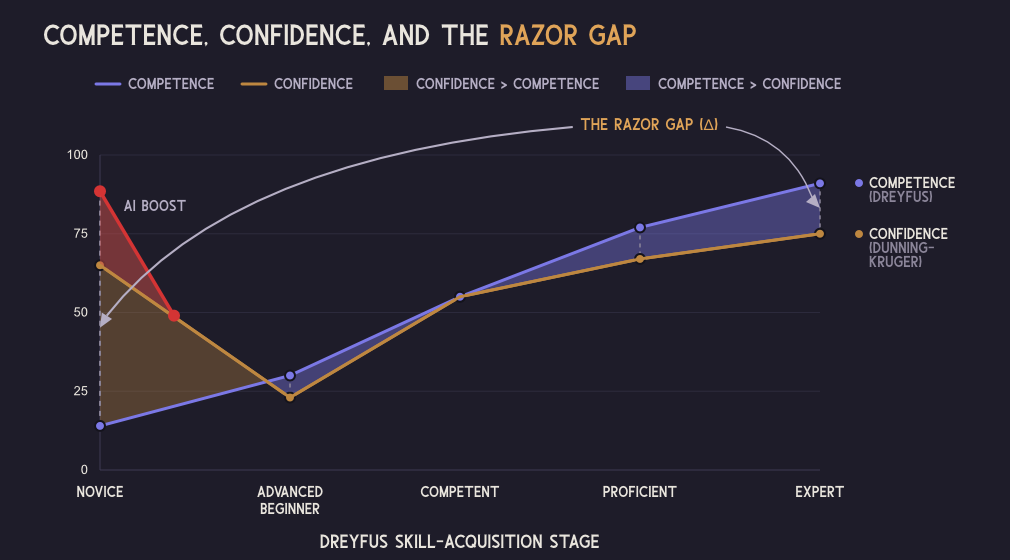
If you squint, the shape looks like a straight razor: a wide blade on the left where confidence runs ahead of competence, tapering toward the handle as the two converge. So I call the space between the lines the Razor Gap:
Razor Gap (Δ) = expressed Confidence − demonstrated Competence
This isn’t a scientific measurement, but more of a mental model and a practical name for that space or gap that opens when there is a “miscalibration” between someone’s demonstrable competence and their self-assessed confidence. The wider this “Razor Gap,” the more distorted reality becomes for the person, and this can be very damaging for them or those around them.
- When the gap is positive, confidence exceeds competence - you may think you know (much) more than you do.
- When it is near zero, the two are aligned - this would really be ideal.
- When it is negative, competence exceeds expressed confidence - a wealth of knowledge and/or experience may lead to hesitancy.
Note that neither direction is automatically “the problem.” A large positive gap can make an inexperienced person reckless. A large negative gap can keep a capable person reserved, which is its own kind of failure (the room loses the perspective it most needed).
The goal is Razor Gap Awareness. Recognizing your own gap and potential gaps in others. Enough confidence to act, enough humility to see uncertainty, enough self-awareness to know when another perspective is needed.
In the illustration/graph …
- the Novice begins with a wide positive gap - a little knowledge or skill can be a dangerous thing
- The Advanced Beginner’s confidence drops as the wealth of details become visible.
- Confidence and competence align around the Competent stage.
- The Proficient and Expert stages show a modest negative gap - not because experts lack confidence, but because they understand many details, have experiences, and understand boundary conditions - this helps them to see how much remains uncertain.
AI is amplifying or “sharpening” the “Novice Razor Gap” - meaning that someone can get much more information more quickly about a topic, problem, or domain early on now - AND feel much more confident about that information (because, “hey, it came from an AI”) - the red “blade” on the left of the chart.
All of this, while still being very early on the curve of competence, learning, and actual skill acquisition and knowledge about a particular topic or domain.
Note: This is a pattern that many (including myself) have observed, but clearly not a claim that every person follows the same path.
How Hanlon’s Razor could cut the wrong thing
Imagine a meeting where someone proposes putting an AI assistant in front of customers.
Someone new to the technology makes the case: “It already answers these questions better than our help pages do. Let’s let it handle the common ones.” The statement is simple, confident, and not obviously wrong. Done carefully, it might even be right.
But another person, who has actually put one of these in front of real customers starts asking questions instead.
The first questions might be about the answers themselves. What does it do when it does not know? Say so, or guess? Where is it reading our policy from, and who updates that when the policy changes? If it tells a customer we offer something we do not, are we bound by what it said? Whose name is on that answer? Ours, or the vendor’s?
Then the harder issues, about how we would ever know. Nobody files a ticket to report a confident answer, they act on it, and we hear about it weeks later, from somewhere else, if at all. And when we say it answers better than our help pages … better on which questions, judged by who/how? The ones we thought to test, or the ones people actually ask at eleven at night when something has already gone wrong?
The second answer sounds less decisive because that person can see more of the system. The hesitation is the expertise. But hesitation is not what a room under time pressure rewards.
Hesitation isn’t a lack of expertise - it is the expertise
Several bad assumptions can now enter the conversation:
- We may mistake the newcomer’s confidence for competence.
- We may mistake the expert’s qualifications for indecision.
- We may interpret questions as resistance rather than risk discovery.
- We may interpret a wrong answer as laziness, arrogance, or bad intent.
- We may use Hanlon’s Razor dismissively - “they just do not understand” - rather than helping them understand.
That last one is worth thinking about a good minute. The razor is supposed to protect the person you are judging. Used carelessly, it becomes a more polite way of writing them off.
The razor is most useful as a pause:
Before I assign a motive, what differences in knowledge, experience, context, incentives, or confidence could also explain what I am seeing?
That question creates room for curiosity without requiring naivety.
What can help direct the conversation?
Ask questions that reveal the reasoning
Instead of asking only, “What do you recommend?” try:
- What assumptions does this recommendation depend on?
- Which parts are well understood, and which remain uncertain?
- What could go wrong with this? If this fails in production, what’s the most likely cause?
- What evidence would change your mind?
- Have you seen this situation before, or are you reasoning from analogy?
These questions make the Razor Gap visible without putting anyone on trial.
Correct without shame
If limited knowledge already makes self-assessment difficult, embarrassment only makes learning harder. Publicly diagnosing someone with the Dunning–Kruger effect is rarely helpful - and carries a certain irony, since confidently labeling another person’s competence from the outside is precisely the move the research warns about.
Challenge the claim. Test the assumptions. Provide evidence (ask for evidence). Invite revision. Leave the person’s dignity intact.
Separate what you know from how sure you feel
Try using distinct language:
- “I know this because …”
- “My current understanding is …”
- “I suspect …”
- “I am confident about X but uncertain about Y.”
- “I have not worked directly in this part of the domain.”
This is especially valuable right now, when the same person can be a genuine expert in their own field and a complete novice in the tool they are being asked to adopt.
Make updating visible
When new evidence changes your position, say so plainly: “I was assuming the assistant would tell us when it was not sure. I have now watched it answer confidently either way, so I am changing my recommendation.”
That is not losing a debate. It is demonstrating calibration - and narrowing the Razor Gap in public, where it does the most good.
Do not weaponize the models
The Dreyfus stages are not a hierarchy of human worth. Dunning–Kruger is not a sophisticated way to call someone stupid. Hanlon’s Razor is not permission to ignore harmful patterns.
Don’t use the razor to cut other people
We are all novices somewhere, and we occupy different stages within the same project. The expert in the craft may be the advanced beginner in the regulation that now governs it. The expert in the tool may be the novice in the work it is being pointed at. Healthy collaboration begins when people can contribute expertise without pretending it is universal.
A short Razor Gap check
Before a consequential decision or a heated debate, ask the group four questions:
- What do we know? Evidence and relevant experience.
- What are we assuming? The premises nobody has said out loud.
- How confident should we be? Match certainty to the strength of the evidence.
- What else could explain this? Apply Hanlon’s Razor before assigning motives.
These questions will not eliminate disagreement. They will make it more productive.
Back in the room
Go back to the meeting at the start of this post. The confident newcomer and the hesitant veteran are still there, and nothing in the razor tells you which one is right. The newcomer might be on to something big. The veteran might be seeing ghosts.
What these three ideas together give you instead is a way to read the room. Hanlon’s Razor says what not to assume. Dreyfus suggests where each person is likely standing. Dunning and Kruger say how much to trust the confidence you are hearing, including your own. Used that way, they say more about how you are listening than about who is talking.
But now with these insights, you can use your razor sharp skills to cut away at the confusion, help guide the conversation, keeping track of what the group knows, what we still need to learn, and help everyone work together to uncover what they can build together as a team with different abilities and experiences.



Leave a comment